

Are you spending hours memorizing long lists of Swedish words, only to forget them by the end of the week? You’re not alone.
Word lists are a straightforward way to expand your Swedish vocabulary. But for most learners, they just don’t work.
Let’s break down why word lists fail — and what works better instead.
Why Word Lists Often Fail
1. Words Are Isolated
You might memorize “en stol” (a chair), but still have no idea how to say “I sit on a chair” or describe what the chair looks like in a real sentence.
2. No Context
Without real-life context, your brain has nothing to connect the word to. You’re left with a floating word and no clue when or how to use it.
3. No Visual or Emotional Connection
Research shows we retain information better when it’s linked to imagery or emotion. Word lists rarely offer either.
4. Passive Learning
Reading and memorizing are not the same as using. With word lists, you’re recognizing vocabulary, not actively producing it.
That’s why visual learning techniques — like mind maps — can revolutionize how you learn Swedish vocabulary.
Try Mind Mapping for Deeper Learning
A mind map allows you to visually connect:
- Vocabulary → to topics
- Topics → to real-life situations
- Grammar → to actual usage
Let’s say you’re learning the topic “kök” (kitchen). A mind map might connect:
- Verbs: laga, äta, baka
- Nouns: kylskåp, kastrull, bord
- Adjectives: varm, god, ren
- Phrases: Jag lagar mat, Vi sitter vid bordet, Jag bakar en kaka
Instead of learning isolated words, you’re creating a web of meaning, which your brain can recall much faster and more naturally.
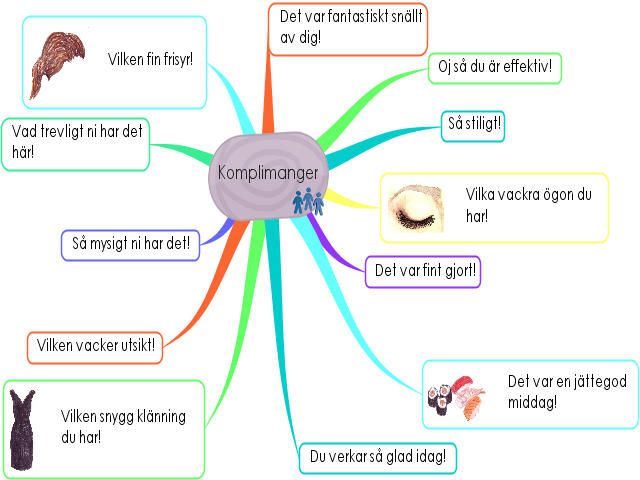
Source: https://vardsvenska.fi/
Make Smarter Flashcards
Flashcards can still be powerful — if you upgrade them.
Use tools like Anki or Quizlet, but don’t just write “en stol = chair.” Add:
- A picture of a chair
- An example sentence: “Jag sitter på en stol.”
- Audio of the correct pronunciation
This way, you’re engaging more parts of the brain – reading, seeing, hearing, and understanding context. All of this supports long-term Swedish vocabulary retention.
Use Context-Based Reading
Instead of memorizing lists, read short Swedish texts around one topic (like health, food, or family). Underline new words and create your own sentences using them.
This method helps you learn Swedish vocabulary within structure and meaning, making it easier to use the words later.
Use Spaced Repetition (Not Just Repetition)
Words must move from short-term to long-term memory to stick.
Review them at increasing intervals:
1 day → 3 days → 1 week → 2 weeks → 1 month
Spaced repetition works brilliantly with mind maps and flashcards.
Use It or Lose It
Language lives in speaking and writing. Don’t wait until you’re “ready” to speak Swedish. Use new vocabulary right away in:
- Simple conversations
- Journal entries
- Voice memos to yourself
- Practice sessions with a teacher
The more you use words, the more confident you’ll feel using Swedish vocabulary in your daily life.

Source: https://unsplash.com/
Ready to Build Vocabulary That Actually Sticks?
Let us support your Swedish journey with tools that actually work:
- 1:1 Swedish Training – Personalized guidance, real progress
- Group Courses – Join a motivated group at your level
- YKI Mind Map Video Course – Study smarter, not harder (ideal for A2+ learners)
Curious which option fits you best? Click here to learn more or get in touch. Let’s make your Swedish vocabulary stronger, faster, and ready for real life.