How to Learn Swedish: A Step-by-Step Guide for Beginners
28/09/2026
Short answer: start with pronunciation and the most common everyday words, study a little every day instead of a lot once a week, listen to real Swedish from the first week, and start speaking early. Pick a clear goal, such as a test or a job, so you know what level you are working towards.
This guide walks you through each step, lists free resources you can use today, and explains when self-study is enough and when a teacher saves you time.
Step 1: Start with sounds and pronunciation
Swedish spelling is fairly regular, but some sounds do not exist in English. Learn the vowels early, especially the letters å, ä and ö, and the difference between long and short vowels. Swedish also has a typical melody, where words can go up and down in pitch.
Spend your first days listening and repeating short words out loud. Getting the sounds right from the start is much easier than fixing habits later.
Step 2: Learn your first words
Begin with the words you will use every day: greetings, numbers, days of the week, family, food, and common verbs like vara (to be), ha (to have), göra (to do) and vilja (to want). Many Swedish words look similar to English, such as hus (house), bok (book) and vatten (water), which gives you a quick start.
Learn every noun together with its article, en or ett, because it affects the rest of the sentence. Our article on how to learn Swedish vocabulary faster explains simple methods that make new words stick.
Step 3: Understand basic sentence order
Swedish word order is close to English, with one important rule: in a main statement, the verb comes in second place. So you say Idag åker jag till jobbet (literally "Today go I to work"). Learn this rule early and you will sound natural much faster.
Verbs are simple too: they do not change by person. Jag talar, du talar, hon talar all use the same form.
Step 4: Build a simple weekly routine
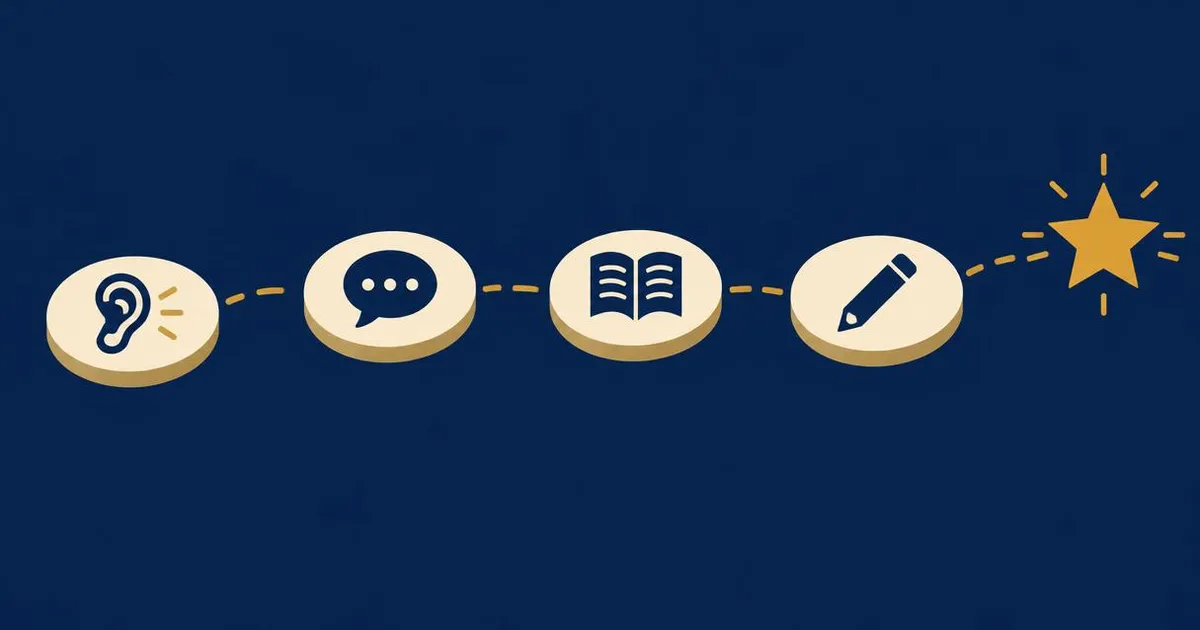
Regular short sessions work better than long, rare ones. A balanced week covers all four skills:
Listening
Listen to Swedish every day, even for a few minutes: slow news, podcasts or children's programmes.
Speaking
Say sentences out loud from the first week. Describe your day, repeat after audio, or talk to a teacher or language partner.
Reading
Read short, easy texts. News written in simple Swedish is ideal for beginners.
Writing
Write a few sentences a day, like a short diary. Writing shows you which words and grammar you still need.
Step 5: Use free resources
Swedish public radio (SR)
Radio Sweden på lätt svenska offers daily news in easy Swedish, read slowly. Good for listening practice; less useful for speaking.
Swedish public TV (SVT)
SVT Nyheter på lätt svenska has short news clips in simple Swedish, and SVT Play has many programmes with Swedish subtitles. Great for hearing everyday language.
Podcasts
Podcasts for learners are easy to fit into your commute. They build listening skills, but you still need to speak yourself.
Apps
Apps are handy for daily vocabulary and a habit. On their own they rarely teach you to hold a real conversation or pass a language test.
Step 6: Know when a teacher helps
Self-study takes you a long way at the start. It usually stops being enough when:
- you understand a lot, but freeze when you have to speak,
- nobody corrects your pronunciation and grammar mistakes,
- you have a deadline, such as a language test for citizenship, work or studies.
A teacher gives you feedback, keeps you on track and prepares you for exactly what your test asks. At Learn Swedish Lab you can study in small groups or one-to-one lessons with professional teachers.
Step 7: Choose your goal
Finnish citizenship
You can prove your language skills with the Swedish YKI test at level 3. Our Total Beginner to YKI course takes you from zero to test level, and our free citizenship guide explains the language requirement.
Swedish citizenship
Our Swedish for Swedish Citizenship (A0-B1) course builds your Swedish step by step.
Studying in Sweden
Universities often ask for the TISUS test. See our TISUS preparation courses.
Healthcare work
Healthcare professionals usually need Swedish at C1. See Swedish for healthcare professionals.
Ready to start with a teacher? Enroll in the Total Beginner to YKI course
Frequently asked questions
What is the best way to start learning Swedish?
Start with pronunciation and everyday words, then study a little every day and speak out loud from the first week.
Can I learn Swedish for free?
Yes, you can go far with free resources like SR and SVT in easy Swedish, podcasts and apps. A teacher helps most with speaking and test preparation.
Is Swedish hard to learn?
For English speakers it is one of the more approachable languages. Read more in Is Swedish hard to learn, and how long does it take?
Should I learn alone or with a teacher?
Alone is fine to begin. If you need to speak confidently or pass a test by a certain date, a teacher gets you there with less guesswork.